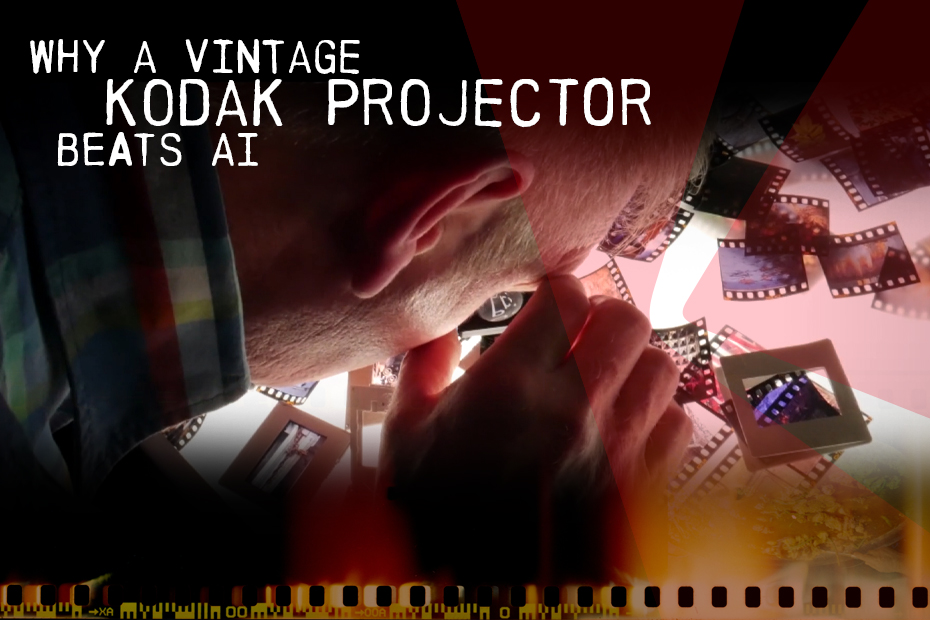
“When I have had this conversation with people about saying, oh, you could create that in Photoshop. Well, yes and no. Because in Photoshop you have to design it and make it happen on screen. With the projection, it evolves in front of your eyes in real time, so you never quite know what is going to happen.”
These are the words of Birmingham based photographer Richard Battye, who has been working behind the lens for more than 30 years. As a biker and a musician, Richard has always admired people who own their own identity and are prepared to stand out. This fascination drove his iconic previous shows, ‘This England’ and ‘Still Dancing’, which explored creativity from the extreme fringes of subculture to the disciplined world of professional ballet.
I recently caught up with Richard ahead of his new exhibition at Nook Gallery in Kings Heath. We discussed his latest body of work, ‘Project’, which takes his thematic exploration of performance, identity and the co-creative nature of photography to a deeper and more poetic level of formalism. Most importantly, I discovered the reasoning behind his deeply collaborative approach and why it entirely rejects generative AI.
A Studio Built on Collaboration
For Richard, the people in front of his lens are true collaborators rather than passive models. The creation of each image in ‘Project’ is a fluid, interactive process. Working in a darkened studio, he projects locally shot slide film onto his subjects. By shooting tethered to a laptop, both Richard and his collaborator can instantly review the results.
As Richard explains, “you see something nearly working and you think actually wouldn’t it be great if that was across here?” This instant feedback loop allows the subject to physically step back into the frame and actively shape the final piece, creating what he describes as “fabulous teamwork.”
The Analogue Antidote
This organic, collaborative energy relies entirely on an authentic, analogue workflow. Using an old school Kodak carousel projector, Richard casts heavily textured images of rusted machinery, rivets, and Victorian brickwork onto the soft contours of the human body.
Because he is mapping a flat projection onto a three dimensional form, the resulting image naturally slips in and out of focus. For Richard, this physical reality is exactly the point. Using post-production or AI to artificially sharpen these contours would be dishonest to that shared moment in the studio. Ultimately, his method is about “keeping the actual skill and craft of photography alive.”
You can see Richard’s physical prints right now at the Nook gallery in Kings Heath. Due to the intimate size of the venue, Richard is also using a Vieunite Textura screen to display a rolling slideshow of 30 additional images, adding a dynamic digital texture to the physical exhibition space.
And of course, photographs from Project are available right now in the Vieunite Art Library.
Watch our full interview via the YouTube video below.
Benedict is Vieunite’s Cultural Director and a lecturer at Nottingham Trent University.