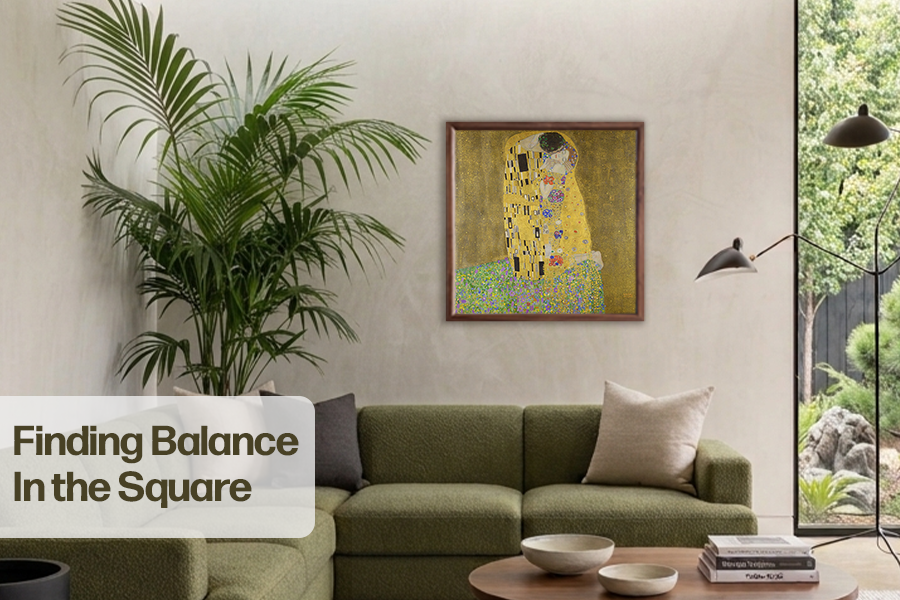
Artwork shown on the digital canvas: Gustav Klimt (1907-1908), “The Kiss”, Österreichische Galerie Belvedere, Image in the Public Domain, via Wikicommons
Most paintings and photographs are rectangular, but Vieunite’s 33″ Square Textura Pro digital canvas provides the essential geometric anchor for grounding interior décor. Because it lacks a dominant axis, the 1:1 ratio naturally cures visual fatigue and creates a sense of sanctuary. To understand how this simple shape transforms a room, we caught up with our Cultural Director, Dr Benedict Carpenter van Barthold. Along the way, we discovered a radical history…
“J.M.W. Turner didn’t have Instagram, but he got the profound, elemental power of the square canvas.” As Ben explained, Turner was fascinated by the swirling effects of storm and often painted spiralling light, mist, and fire. A conventional rectangular frame, with its dominant vertical or horizontal axis, inevitably dissipates this centripetal energy.
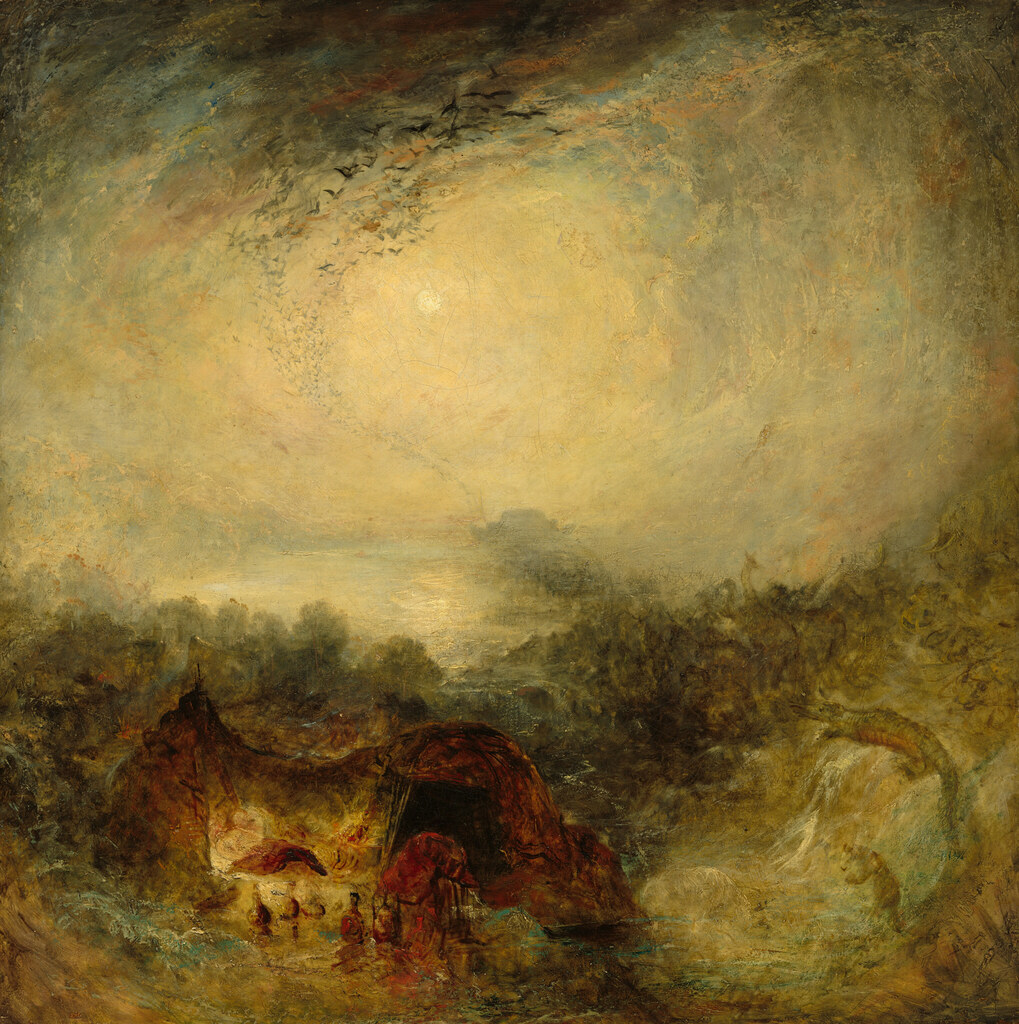
J. M. W. Turner (c. 1843) “The Evening of the Deluge”, The National Gallery of Art, Washington. Image in the Public Domain.
“Even a blank rectangle wants to go somewhere, either horizontally or vertically,” Ben noted. “A square, by contrast, traps the viewer in the eye of the storm, with no escape. This means artists can do something different with a square frame than a standard rectangle.”
It was not until the turn of the twentieth century that the square truly emerged as a widespread compositional force. The Austrian painter Gustav Klimt famously walked with a square cardboard viewfinder to practise seeing the world through this novel ratio, leading to masterpieces like The Kiss and Portrait of Adele Bloch-Bauer I. Soon after, visionaries like Piet Mondrian, who often rotated his canvases into diamonds, embraced the 1:1 canvas.
“But if we are going to talk about square art, we have to mention the undisputed heavyweight champion of radicalism, the Suprematist master, Kazimir Malevich … when he painted his radical Black Square in 1915, it was because the shape abandoned conventional hierarchies. This was a zero point for a new era of art to emerge. Modernism’s new dawn.”
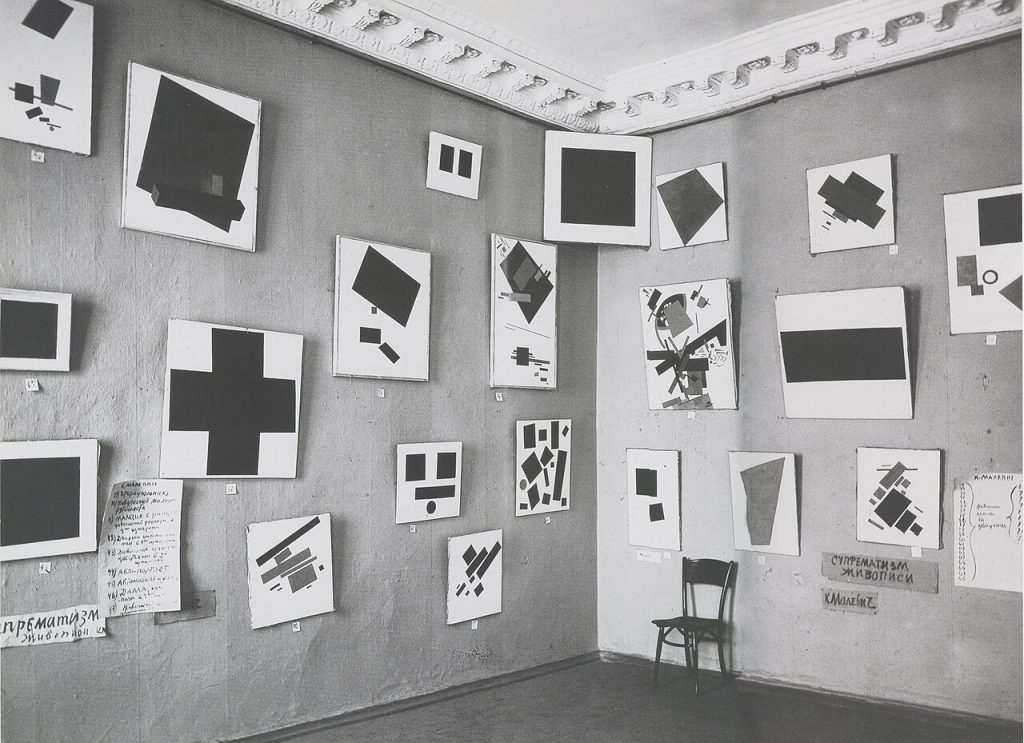
A section of Suprematist works by Kazimir Malevich exhibited for the first time. Black Square is hung in an upper corner of the room, a traditional location for Russian icons. 1915. Image via Wikicommons
The Cultural and Theological Anchor
Ben went on to explain that this shape possesses a far deeper cultural heritage. Malevich’s work, despite its radical appearance, deliberately referenced the Russian Orthodox icons of his childhood.
In historical Christian symbolism, while the circle represents the divine, the square signifies the earthly realm, “the idiomatic four corners of the globe, the four elements, and the four evangelists.” A square icon acts as a deliberate anchor, grounding the divine in a stable, earthly reality. This same geometric interplay defines early Renaissance religious architecture, designed to bring atmospheric space into perfect, Neo-Platonic balance.
Curating the Modern Space
What does all this mean for art lovers today? Here’s Ben’s take: “As Cultural Director for Vieunite, curating works for our Art Library, I continually see the enduring elegance of this format. True, the smartphone era has made the square ubiquitous, and you know, some galleries even encouraged the ratio purely because it made it easier to promote their artist’s work on social media. But the artistic value of the square has nothing to do with the endless scroll. In fact, though this might sound counterintuitive, the square is the antidote to the constant movement that frames our lives today.”
The secret to this, as Ben explained, is in the inherently static nature of the square: in contemporary interior design, a continuous sequence of rectangular frames can leave the eye exhausted, as every rectangle dictates a visual direction. The occasional square introduces a much-needed static breath, offering a moment of visual respite. “I live and breathe art, but – I have to say – solving this problem is an absolute revelation for visual décor”
More importantly, in an era where rectangular screens are ubiquitous, the square offers a deliberate departure from technological norms. A square canvas does not read as a digital screen. Instead, it asserts itself as a considered, tactile feature piece, bringing quiet intentionality to a room and ensuring your chosen artwork harmonises beautifully with your curated space.
And for artists, as Turner knew, there’s just so much to play with…

Vieunite is redefining how people discover and experience art through a curated digital art library and a range of Home and Pro digital canvases. With a mission to make art more accessible, Vieunite brings world-class artwork into homes, businesses, and public spaces, creating new opportunities for both audiences and artists.